In today’s digital economy, data is often described as the new oil. Organizations across industries rely heavily on vast volumes of structured and unstructured data—commonly referred to as big data—to drive decision-making, optimize operations, and gain competitive advantage. However, with this exponential growth comes a critical challenge: managing data effectively while ensuring quality, security, and compliance.
This is where big data governance plays a pivotal role. It is not merely about controlling data but establishing a framework that ensures data is accurate, accessible, secure, and compliant with regulatory standards. Without proper governance, organizations risk poor data quality, legal penalties, and loss of trust.
This article explores best practices for implementing effective big data governance, with a focus on improving data quality and ensuring compliance.
What is Big Data Governance?
Big data governance refers to the set of policies, processes, standards, and technologies used to manage data assets within an organization. It ensures that data is handled properly throughout its lifecycle—from collection and storage to processing and deletion.
Key objectives include:
- Ensuring data accuracy and consistency
- Protecting sensitive information
- Meeting regulatory requirements
- Defining roles and responsibilities for data management
- Enabling data accessibility for authorized users
In essence, it provides a structured approach to managing large-scale data environments.
Importance of Data Quality in Big Data Governance
Data quality is the foundation of any successful data initiative. Poor-quality data leads to inaccurate insights, flawed strategies, and financial losses.
Key Dimensions of Data Quality
- Accuracy – Data must correctly represent real-world values
- Completeness – All required data should be present
- Consistency – Data should be uniform across systems
- Timeliness – Data should be up-to-date
- Validity – Data must conform to defined formats and rules
Organizations that prioritize these dimensions can make better decisions and maintain operational efficiency.
Regulatory Compliance in Big Data
Compliance is a major driver for implementing data governance. Governments and regulatory bodies enforce strict data protection laws to safeguard personal and sensitive information.
Common Compliance Requirements
- Data privacy regulations
- Data retention policies
- Auditability and traceability
- Consent management
- Data breach reporting
Failure to comply can result in severe penalties, reputational damage, and legal consequences.
Core Components of Big Data Governance
1. Data Governance Framework
A governance framework defines the structure and rules for managing data. It includes:
- Policies and standards
- Governance committees
- Decision-making processes
- Escalation procedures
A well-defined framework ensures consistency and accountability.
2. Data Stewardship
Data stewards are responsible for maintaining data quality and enforcing governance policies. Their duties include:
- Monitoring data accuracy
- Resolving data issues
- Ensuring compliance with standards
- Collaborating with IT and business teams
Strong stewardship ensures that governance policies are effectively implemented.
3. Metadata Management
Metadata provides context about data, such as its source, format, and usage.
Benefits include:
- Improved data discovery
- Better understanding of data lineage
- Enhanced transparency
Effective metadata management is crucial for large-scale data environments.
4. Data Lifecycle Management
Data lifecycle management involves handling data from creation to deletion.
Stages include:
- Data creation or acquisition
- Storage and processing
- Usage and sharing
- Archiving
- Deletion
Proper lifecycle management ensures compliance with retention policies and reduces storage costs.
Best Practices for Data Quality
1. Establish Clear Data Standards
Define consistent formats, naming conventions, and validation rules. This helps maintain uniformity across datasets.
2. Implement Data Validation and Cleansing
Automated tools can identify and correct errors such as duplicates, missing values, and inconsistencies.
3. Monitor Data Continuously
Data quality should not be a one-time effort. Continuous monitoring ensures issues are detected early.
4. Use Data Profiling Techniques
Data profiling helps understand the structure and quality of data. It identifies anomalies and patterns that may indicate problems.
5. Promote Data Ownership
Assign clear ownership to individuals or teams. When people are accountable, data quality improves significantly.
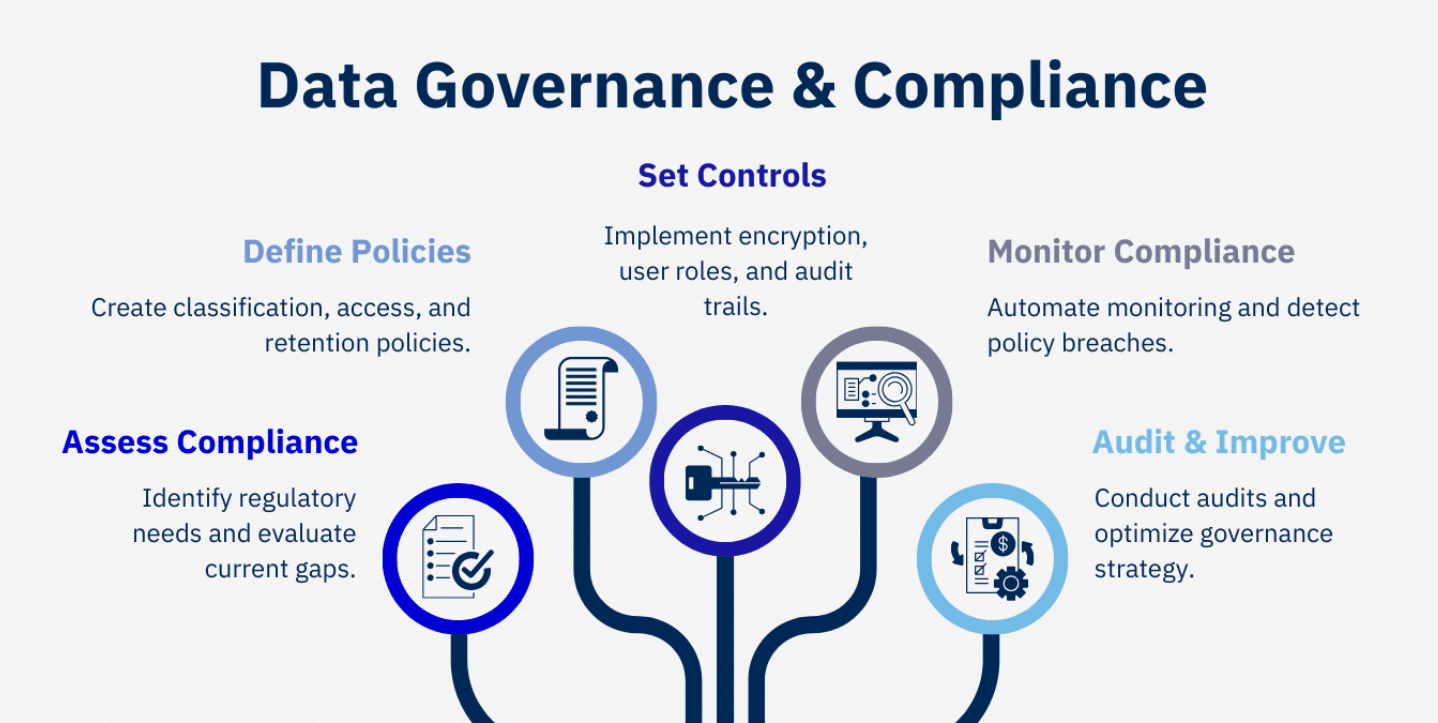
Best Practices for Compliance
1. Understand Applicable Regulations
Organizations must identify which regulations apply to their operations and ensure alignment with those requirements.
2. Implement Access Controls
Limit data access based on roles and responsibilities. This reduces the risk of unauthorized access.
3. Maintain Audit Trails
Keep records of data access and changes. This helps demonstrate compliance during audits.
4. Encrypt Sensitive Data
Encryption protects data both at rest and in transit, ensuring confidentiality.
5. Conduct Regular Compliance Audits
Periodic audits help identify gaps and ensure ongoing adherence to regulations.
Role of Technology in Big Data Governance
Technology plays a crucial role in enabling governance at scale.
Key Tools and Technologies
- Data cataloging tools
- Data quality management platforms
- Data lineage tracking systems
- Security and encryption tools
- Compliance monitoring software
Automation reduces manual effort and improves accuracy.
Challenges in Big Data Governance
Despite its importance, implementing data governance is not without challenges.
1. Data Silos
Different departments may store data separately, leading to inconsistencies.
2. Lack of Skilled Personnel
Organizations often struggle to find experts in data governance.
3. Rapid Data Growth
The sheer volume of data makes governance complex.
4. Changing Regulations
Keeping up with evolving laws can be difficult.
5. Resistance to Change
Employees may resist new governance policies and processes.
Strategies to Overcome Challenges
1. Foster a Data-Driven Culture
Encourage employees to value data as a strategic asset.
2. Provide Training and Education
Equip teams with the knowledge needed to implement governance practices.
3. Leverage Automation
Use technology to streamline processes and reduce manual effort.
4. Start Small and Scale
Begin with a pilot project and expand gradually.
5. Align Governance with Business Goals
Ensure that governance initiatives support organizational objectives.
Benefits of Effective Big Data Governance
Organizations that implement strong governance practices can achieve:
- Improved data quality and reliability
- Enhanced decision-making
- Reduced compliance risks
- Increased operational efficiency
- Better customer trust and satisfaction
These benefits contribute directly to long-term success.
Future Trends in Big Data Governance
1. AI-Driven Governance
Artificial intelligence is being used to automate data classification, quality checks, and anomaly detection.
2. Real-Time Data Governance
Organizations are moving toward real-time monitoring and enforcement of policies.
3. Cloud-Based Governance Solutions
Cloud platforms provide scalable and flexible governance capabilities.
4. Privacy-First Approaches
With increasing awareness of data privacy, organizations are prioritizing privacy-centric governance models.
5. Integration with Data Analytics
Governance is becoming closely integrated with analytics to ensure reliable insights.
Conclusion
Big data governance is no longer optional—it is a necessity for organizations that rely on data-driven decision-making. By implementing best practices for data quality and compliance, businesses can unlock the full potential of their data while minimizing risks.
A successful governance strategy requires a combination of clear policies, strong leadership, advanced technology, and a culture that values data integrity. While challenges exist, they can be overcome with the right approach and commitment.
As data continues to grow in volume and importance, organizations that prioritize governance will be better positioned to thrive in an increasingly competitive and regulated environment.
Final Thoughts
Investing in big data governance is an investment in the future. It ensures that data remains a valuable, trustworthy, and compliant asset. By focusing on quality and compliance, organizations can not only meet regulatory requirements but also gain a significant competitive edge.
Start building your governance framework today—and transform your data into a powerful strategic advantage.